Analysis of endometrial thickness by age groups in asymptomatic postmenopausal women
DOI:
https://doi.org/10.17532/jhsci.2026.3050Keywords:
Endometrial thickness, postmenopause, transvaginal ultrasound, asymptomatic women, age groupsAbstract
Introduction: Endometrial thickness (ET) represents an important ultrasonographic parameter in the assessment of endometrial health in postmenopausal women. Transvaginal ultrasound is currently the standard non-invasive method for evaluating the endometrium, particularly in the context of early detection of pathological changes. The aim of this study was to analyze ET according to age groups in asymptomatic postmenopausal women and to determine whether statistically significant differences exist among the observed age groups.
Methods: A prospective cross-sectional study was conducted at the Department of Gynaecology of the Cazin Primary Health Care Centre from January 01, 2025, to March 31, 2026. The study included 386 postmenopausal women, defined as having an absence of menstruation for at least 12 months. ET was measured by transvaginal ultrasound. Statistical analysis was performed using the Statistical Package for the Social Sciences software (version 27), applying One-way analysis of variance (ANOVA) and Scheffé post hoc test.
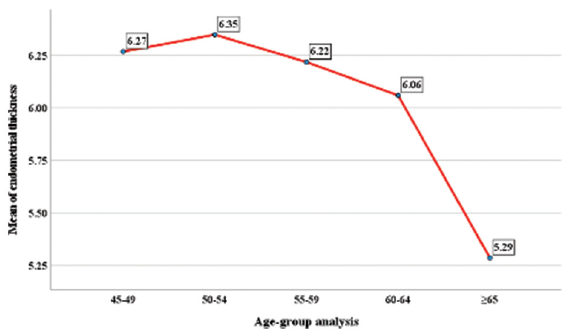
Results: The mean ET in the total cohort was 6.16 ± 3.62 mm (95% confidence interval: 5.80-6.53), with a range from 1.0 to 21.2 mm. The mean values across age groups were 6.27 mm (45-49 years), 6.35 mm (50-54 years), 6.22 mm (55-59 years), 6.06 mm (60-64 years), and 5.29 mm (≥65 years), showing a slight decreasing trend with increasing age. One-way ANOVA did not reveal statistically significant differences among the groups (F = 0.534; p = 0.711). Scheffé post hoc analysis also showed no significant differences among individual age groups (p > 0.05).
Conclusions: ET in asymptomatic postmenopausal women shows relatively stable values across different age groups. The results indicate that age alone is not a significant factor influencing ET in this population.
Downloads
Downloads
Published
License
Copyright (c) 2026 Samir Porić, Šemso Rošić, Asmir Aldžić, Mirza Rošić

This work is licensed under a Creative Commons Attribution 4.0 International License.