Predictive value of pre-operative ocular biometric parameters for visual outcomes following Evolux extended depth-of-focus intraocular lens implantation
DOI:
https://doi.org/10.17532/jhsci.2026.3143Keywords:
Cataract surgery, biometric eye parameters, extended depth-of-focus intraocular lens, Evolux intraocular lensAbstract
Introduction: Extended depth-of-focus (EDOF) intraocular lens (IOLs) are designed to provide a continuous range of functional vision, particularly at distance and intermediate ranges, while reducing spectacle dependence and photic
phenomena associated with multifocal designs. However, post-operative visual performance may be influenced by individual ocular biometric characteristics, and evidence regarding their predictive value remains limited. This study aimed to evaluate whether pre-operative ocular biometric parameters can predict visual outcomes following implantation of the Evolux™ EDOF IOL.
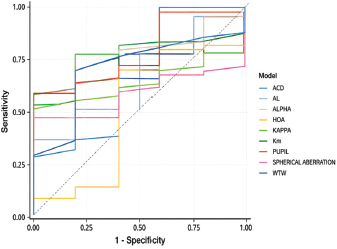
Methods: In this prospective, observational study, 50 eyes from patients with age-related cataract underwent phacoemulsification and Evolux EDOF IOL implantation. Pre-operative assessments included keratometry, axial length, anterior chamber depth, white-to-white corneal diameter, pupil diameter (PD), higher-order aberrations, and angles alpha and kappa. Visual acuity outcomes were measured 3 months postoperatively. Receiver operating characteristic curve analysis and multivariable models determined biometric predictors of favorable visual function.
Results: Evolux EDOF IOL implantation resulted in excellent mean uncorrected and corrected distance visual acuity (UDVA: 0.027 logarithm of the minimum angle of resolution [logMAR]; CDVA: 0.0056 logMAR) as well as intermediate
visual acuity (uncorrected intermediate visual acuity: 0.104 logMAR; corrected intermediate visual acuity: 0.008 logMAR) at 3 months. Among pre-operative parameters, PD, mean keratometry, and angle alpha (AA) demonstrated the highest discriminative ability for predicting favorable uncorrected visual outcomes. Multivariable analysis showed that the combination of PD and AA improved predictive accuracy (area under the curve = 0.902, sensitivity 95.6%, specificity 80.0%).
Conclusion: Pre-operative assessment of PD and AA improves prediction of post-operative visual outcomes following Evolux EDOF IOL implantation. Incorporating these biometric parameters into patient selection and counseling may optimize refractive cataract surgery outcomes. Further research is required to validate these findings and establish clinical thresholds.
Downloads
Downloads
Published
License
Copyright (c) 2026 Ajla Skopljak-Salkica, Vernesa Sofić-Drino, Ivana Gabrić, Melisa Ahmedbegović-Pjano, Alma Biščević, Amina Valjevac, Nikica Gabrić

This work is licensed under a Creative Commons Attribution 4.0 International License.