Prevalence and antimicrobial susceptibility of Ureaplasma spp. and Mycoplasma hominis isolated from cervical swabs of pregnant women: A 7-month microbiological study
DOI:
https://doi.org/10.17532/jhsci.2025.3036Keywords:
Ureaplasma spp., Mycoplasma hominis, pregnancy, cervical swab, antimicrobial susceptibility, bacterial loadAbstract
Introduction: Ureaplasma spp. and Mycoplasma hominis are among the most frequently identified microorganisms within the female urogenital tract. Although they are often detected in asymptomatic individuals, their presence during
pregnancy has been associated with adverse outcomes, including preterm birth, spontaneous abortion, and intrauterine infection. However, their exact clinical significance remains incompletely defined. This study aimed to assess their prevalence, bacterial load, and antimicrobial susceptibility among pregnant women.
Methods: A retrospective analysis was performed using routinely collected laboratory data, with no additional intervention. A total of 158 cervical swab specimens collected over a 7-month period were included in the study. Identification,
quantification, and susceptibility testing were carried out using the Mycoplasma IST3 system. A bacterial load threshold of ≥104 CFU/mL was defined as clinically relevant. Statistical evaluation was conducted using the Chi-square test.
Results: Out of 158 samples, genital mycoplasmas were detected in 39.9% of cases. Ureaplasma spp. represented the most frequently isolated organism, while M. hominis was identified less often and predominantly in mixed infections.
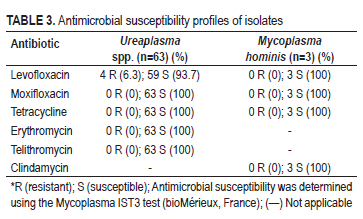
The majority of positive specimens demonstrated bacterial concentrations ≥104 CFU/mL. Overall, isolates exhibited high susceptibility to most tested antimicrobial agents, with resistance observed only to levofloxacin. Post-treatment follow-up indicated that persistence of infection was relatively frequent.
Conclusion: These findings indicate that genital mycoplasmas are commonly present in pregnant women and may persist despite appropriate antimicrobial therapy. This emphasizes the importance of routine microbiological follow-up and careful selection of treatment strategies to minimize potential adverse pregnancy outcomes.
Downloads
Downloads
Published
License
Copyright (c) 2026 Emina Bajramović Muratović, Asmir Aldžić, Anis Cerovac

This work is licensed under a Creative Commons Attribution 4.0 International License.