Prevalence and distribution of metabolic syndrome components among students at a public university in Central Java, Indonesia
DOI:
https://doi.org/10.17532/jhsci.2026.2942Keywords:
Indonesia, metabolic syndrome, university students, cardiometabolic riskAbstract
Introduction: University students undergo lifestyle changes that may increase early cardiometabolic risk. This study estimated the prevalence of metabolic syndrome (MetS) and described its components among students at a public university in Central Java, Indonesia.
Methods: A cross-sectional study was conducted among students from May 2024 to April 2025. Data collection included structured questionnaires, anthropometric measurements, blood pressure (BP) assessment, and fasting blood biomarker analysis. MetS was defined using the International Diabetes Federation. Statistical analyses included the Mann–Whitney U and Pearson’s χ2 test.
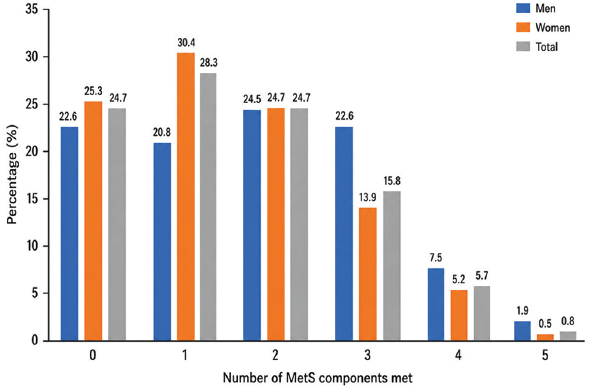
Results: The prevalence of MetS was 21.9% (54/247). The most prevalent component was elevated waist circumference (54.3%), followed by low high-density lipoprotein cholesterol (HDL-C) levels (40.5%). Compared with women, men had significantly higher prevalences of elevated BP (prevalence ratio [PR] = 1.79; 95% confidence interval [CI] 1.15-2.77; p = 0.013), elevated triglycerides (PR = 2.00; 95% CI 1.06-3.77; p = 0.034), and elevated fasting plasma glucose (PR = 2.29; 95% CI 1.30-4.04; p = 0.005). Students with a body mass index (BMI) ≥25 kg/m2 showed the largest PR for MetS (PR = 4.96; 95% CI 2.90-8.46; p < 0.001).
Conclusion: MetS was identified in 21.9% of the study population. Among the selected factors examined, BMI ≥25 kg/m2 was associated with the largest unadjusted PR for MetS. Elevated waist circumference showed the highest prevalence among MetS components followed by low HDL-C levels. These findings suggest early cardiometabolic risk among students at the participating university. However, because the study was conducted at a single institution using non-probability sampling, the results may not generalize to all Indonesian university students.
Downloads
Downloads
Published
License
Copyright (c) 2026 Andi Daramusseng, Sulistiyani Sulistiyani, Suhartono Suhartono, Yusniar Hanani Darundiati

This work is licensed under a Creative Commons Attribution 4.0 International License.