Breast self-examination for prevention and early detection of breast cancer: Insights into knowledge, attitudes, and practices of Sarajevo University female students
DOI:
https://doi.org/10.17532/jhsci.2025.2892Keywords:
Attitude, breast cancer, breast self-examination, knowledge, practiceAbstract
Introduction: Breast cancer represents a global public health challenge, often diagnosed at advanced stages due to a lack of awareness and insufficient practice of breast self-examination (BSE). This study aims to assess and compare the knowledge, attitudes, and practices of female students regarding BSE in the context of breast cancer prevention and early detection.
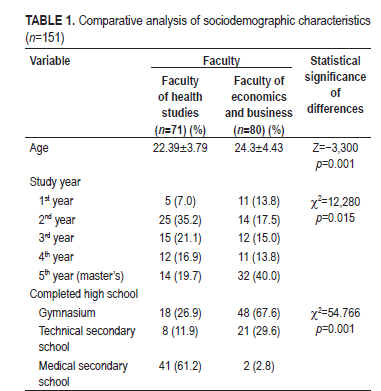
Methods: The cross-sectional study was conducted from March to April 2023 and included 151 female students from the Faculty of Health Studies and the Faculty of Economics and Business University of Sarajevo. The research instrument was a modified questionnaire based on an existing questionnaire from previous research and adapted to the objectives of this study.
Results: The results showed that almost all participants were familiar with BSE, with no significant differences between faculties. Students from the Faculty of Health Studies were more likely to report knowing the right time for BSE (45.1%), while students from the Faculty of Economics and Business were more uncertain and relied more on information from the internet. The main reason for not performing the BSE was a lack of knowledge about the correct technique, which was most frequently stated by economics students. Nevertheless, the majority of participants (91.4%) recognized BSE as an important method for early detection of breast tumors, highlighting the need for further education to strengthen practical skills.
Conclusion: The study found that although most students are aware of the importance of BSE, regular practice is low, mainly due to uncertainty about the correct technique. The results of this study show that there is a need to integrate targeted educational programs into university curricula and health promotion campaigns to reinforce preventive behaviors.
Downloads
Downloads
Published
License
Copyright (c) 2025 Nerma Bašić, Suada Branković, Jasmina Mahmutović, Amer Ovčina, Mohammed Abou El - Ardat, Đenana Šaldo, Mediha Muslić – Musić , Amela Salihović, Vedran Đido

This work is licensed under a Creative Commons Attribution 4.0 International License.