The Multiple Sclerosis Intimacy and Sexuality Questionnaire-15: Validity, reliability, and factor structure of Croatian version
DOI:
https://doi.org/10.17532/jhsci.2025.2877Keywords:
Croatia, multiple sclerosis, reliability, sexual health, validityAbstract
Introduction: Multiple sclerosis (MS) is a chronic progressive disease of the central nervous system that results in a wide range of clinical manifestations including sexual dysfunction (SD) and impaired sexual health. The aim of this study was to assess the validity, reliability, and factor structure of the MS Intimacy and Sexuality Questionnaire-15 (MSISQ-15) in Croatian-speaking patients.
Methods: Participants were 90 patients with MS participated in the study, including 50 women and 40 men (44 ± 13 years). The MSISQ-15 was utilized as the instrument, with its Croatian version developed using the forward-backward translation. Descriptive analysis was performed on the data. Reliability was assessed through Cronbach’s α and test–retest analysis. Pearson’s correlation was examining the relationship between the total scale and the SD subscales. Construct validity was evaluated with exploratory factor analysis.
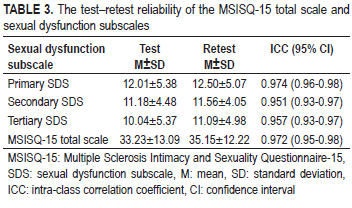
Results: The mean for the total scale and its primary, secondary, and tertiary SD subscales were 33.39 ± 12.06, 12.05 ± 5.36, 11.22 ± 4.51, and 10.12 ± 5.39, respectively. The total scale demonstrated high internal consistency (α = 0.94). Each SD subscale exhibited high internal consistency (α = 0.84-0.92). The intra-class correlation for the SD subscales and the total scale was between 0.95 and 0.97. There was a strong relationship between the total scale and the SD subscales (r = 0.76-0.93). Bartlett’s test of sphericity indicated a high and significant correlation (χ2 = 939.94, p < 0.001). The Kaiser–Meyer–Olkin measure is 0.87. The factors extracted accounted for 65.90% of the total variance, with factor loadings ranging from 0.61 to 0.84.
Conclusion: The Croatian MSISQ-15 version has demonstrated validity, reliability, and factor structure in assessing health-related quality of life in Croatian-speaking patients.
Downloads
Downloads
Published
License
Copyright (c) 2025 Zvonimir Uzarević, Filip Petković, Anamarija Soldo Koruga, Ivana Kampić, Zeljka Popijač, Silva Butković Soldo

This work is licensed under a Creative Commons Attribution 4.0 International License.